
If you are planning a home, office, retail or industrial renovation in Singapore, one of the first trade decisions you will face is whether to install a false ceiling — and if so, which type. Plasterboard, gypsum board, fire-rated, acoustic and decorative ceilings all serve different needs, and the price difference can run into thousands of dollars on a medium-sized project. This guide breaks down every common false ceiling type installed in Singapore, what each one costs, what permits you may need (HDB, BCA, SCDF), and how to choose a contractor without overpaying. As a direct BCA-registered plasterboard and false ceiling contractor in Singapore, Fortified has installed thousands of ceilings across HDB flats, condominiums, landed homes, offices, retail units and F&B outlets — everything below comes from on-the-ground experience.
A false ceiling — sometimes called a suspended ceiling, drop ceiling or dropped ceiling — is a secondary ceiling hung below the main structural ceiling. In Singapore, the most common false ceiling material by far is plasterboard, also known as gypsum board or drywall board. Plasterboard panels are manufactured from a gypsum core sandwiched between two heavy-duty paper liners, then cut to size and screwed onto a lightweight galvanised steel grid suspended from the concrete slab above.
The advantage over a traditional wet-applied plaster ceiling is speed. A plasterboard ceiling in Singapore for a four-room HDB flat can be installed, jointed, sanded and painted in under a week. Traditional plaster ceilings require extended drying times and much greater labour cost. Almost every plaster ceiling contractor in Singapore today installs plasterboard instead, which is why traditional wet-plaster ceilings are now rare in Singapore outside of heritage or luxury renovation projects.
Plasterboard is also lightweight, non-combustible (when specified correctly), and easy to modify — you can cut access panels for aircon servicing or wiring work and patch the ceiling back to a seamless finish without rebuilding the whole structure.
Not every false ceiling is the same. The right choice depends on your building type, fire compliance requirements, acoustic needs and budget. Here are the six most common types installed in Singapore.
The workhorse of Singapore renovation. Standard 9mm or 12mm plasterboard panels on a metal grid, jointed, sanded, primed and painted. Suitable for almost all HDB flats, condominium units and landed homes. Typical installed cost ranges from S$6 to S$9 per square foot depending on ceiling height, design complexity and whether cove lighting or cornices are included. Expect 3 to 5 working days for a typical flat.
“Gypsum board” and “plasterboard” are often used interchangeably in Singapore, but some contractors use “gypsum board” to mean the thicker 15mm or 18mm boards used in larger commercial projects. The installation method is the same, but the heavier boards offer better sag resistance over long spans and slightly better acoustic damping. Commonly used in office fit-outs and retail ceilings above 3 metres.
Required by the Singapore Civil Defence Force (SCDF) for certain commercial and industrial spaces, particularly where fire compartmentation is needed between floors or separating occupancies. Fire-rated plasterboard systems typically achieve a 1-hour or 2-hour fire resistance rating when specified and installed correctly. The board itself contains glass fibres and vermiculite that delay fire penetration. Expect to pay 30% to 60% more than a standard plasterboard ceiling in Singapore, reflecting both the material cost and the additional labour for sealing joints and service penetrations.
Used in offices, meeting rooms, music studios, F&B outlets and medical clinics where sound absorption is critical. Acoustic ceilings use perforated plasterboard, mineral fibre tiles or specialist acoustic panels suspended in a visible T-grid. The perforations absorb mid-range speech frequencies, improving speech privacy and reducing reverberation. A 1,000 square foot acoustic ceiling typically costs S$12 to S$18 per square foot depending on the panel specification.
Decorative trim installed where the ceiling meets the wall. Cornices are profiled mouldings that give a classical finish; L-boxes are dropped rectangular sections that house LED strip lighting for indirect illumination; bulkheads are large stepped-down sections used to define zones within an open layout or to conceal aircon trunking. Most Singapore homes add at least one of these features — LED cove lighting in the living room is almost a default on new BTO renovations.
Tray ceilings, coffered ceilings, vaulted sections, wood-look panels and custom feature ceilings for premium interiors. These are design-led installations that use plasterboard as the base material but add layers of detail — multiple step-downs, integrated lighting, curved sections or applied timber veneer. Pricing is quote-based because every design is different.
A false ceiling is not just a cosmetic upgrade — it performs several functions that are hard to achieve any other way.
1. Sound insulation. Plasterboard with a mineral wool cavity above it significantly reduces noise transmission between floors and between rooms. For anyone in a condominium or office environment, this can be the difference between hearing every footstep above you and having a quiet space.
2. Thermal insulation. In Singapore’s climate, a ceiling cavity acts as a thermal buffer between the concrete slab and your conditioned space. Combined with insulation batts, this can meaningfully reduce aircon load — especially in top-floor units exposed to direct sun on the roof slab.
3. Fire protection. Fire-rated plasterboard systems delay fire spread between compartments, which is a regulatory requirement in many commercial premises and an added safety layer in high-end residential.
4. Concealing building services. Aircon trunking, sprinkler pipes, electrical conduits, data cabling, structural beams and slab soffits are all hidden above a false ceiling. Access panels placed strategically allow servicing without ripping down the whole ceiling.
5. Aesthetic upgrade. A flat, crisp, evenly-painted ceiling with well-executed cove lighting transforms the feel of a space in a way that no paint job on the original slab soffit ever could.
HDB flats. Plasterboard false ceilings are standard in almost every HDB renovation — BTO, resale and older stock. The main constraint is ceiling height: HDB’s minimum clear ceiling height is typically 2.4 metres post-renovation, so on older flats with a 2.6m slab, you have roughly 200mm to play with after accounting for L-boxes and aircon trunking.
Condominiums and landed homes. Here the design vocabulary widens. Taller slabs allow tray ceilings, dropped bulkheads over dining zones and elaborate feature ceilings. Condominium false ceiling work needs MCST approval for any penetration of the structural slab, which we handle as part of our service.
Offices and coworking spaces. Acoustic grid ceilings for the workstation area and plasterboard ceilings in Singapore for meeting rooms and reception are the typical mix. Integration with M&E services — lighting, fire sprinklers, aircon diffusers, cable trays — is the critical coordination point.
Retail shops and F&B outlets. Shop fit-outs in malls, high-street units and standalone cafés often combine exposed industrial ceilings in some zones with feature plasterboard bulkheads over the service counter or brand display walls. F&B kitchens need hygienic, grease-resistant ceiling materials, and separation between the front-of-house ceiling and the kitchen ceiling is often required for SFA compliance.
Industrial and warehouse spaces. Fire-rated plasterboard ceilings over offices within warehouse shells, acoustic ceilings in production areas with noisy machinery, and standard plasterboard in staff welfare areas.
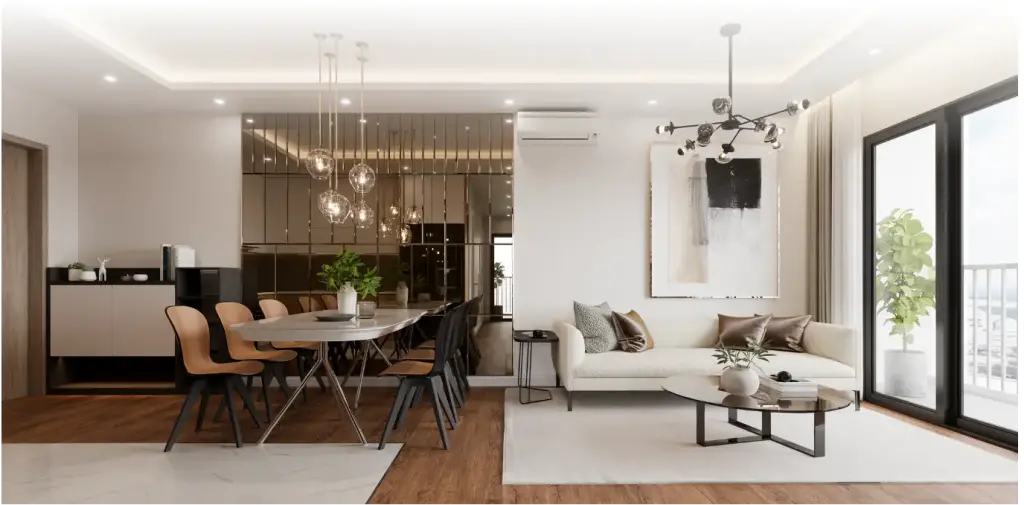
Every Fortified false ceiling project runs through the same five-stage process, refined over years of installations across Singapore.
Stage 1 — Site Survey. We measure the existing space, assess the structural slab, identify existing M&E services running above the ceiling line, and discuss your design intent. For commercial projects we also check fire compliance, loading requirements and MCST or landlord constraints.
Stage 2 — Design and Quotation. Within three working days you receive a fixed-price quotation with ceiling height specified, material spec, lighting layout, cornice or L-box details, and the total timeline. No surprises — the price you see is the price you pay.
Stage 3 — Installation. Our BCA-registered crew installs the galvanised steel grid first, then the plasterboard panels are screwed in place. For a 1,000 square foot project, expect 3 to 7 working days for grid plus board, depending on complexity.
Stage 4 — Jointing, Sanding and Painting. All joints are taped and filled with jointing compound, sanded flat, primed, and finished with two coats of the paint colour of your choice. This is the stage that separates professional work from amateur — poor jointing shows as visible seams after six months.
Stage 5 — Handover and Warranty. Final site walkthrough, snag list rectified, and a full one-year workmanship warranty issued in writing.
Plasterboard false ceiling pricing in Singapore in 2026 generally falls within these bands:
The main cost drivers are ceiling height (higher ceilings mean more scaffolding time), design complexity (multiple step-downs, curves or cove lighting runs), material spec (fire-rated vs standard) and painting finish. A four-room HDB flat with standard plasterboard plus cove lighting in the living and dining rooms typically costs between S$3,500 and S$6,500 installed.
HDB flats. Any renovation using a registered contractor requires an HDB renovation permit, which we apply for on your behalf. HDB specifies a minimum clear ceiling height of 2.4 metres after the false ceiling is installed — if you drop below that, the permit will be rejected.
Commercial and industrial spaces. BCA compliance is standard for any ceiling installation by a registered contractor. Where fire-rated ceilings are specified — typically in commercial premises above a certain occupant load or in industrial buildings with fire compartmentation — SCDF approval may be required. We coordinate these submissions as part of our package where applicable.
Condominiums. The MCST typically requires notification and approval for any renovation involving ceiling work, especially if there is any penetration of the structural slab or shared M&E services.
Most Singapore renovation projects involve a main contractor who sub-contracts the ceiling work to a specialist — and the sub-contractor may in turn use a sub-sub-contractor. Each layer adds a margin, and the quality control weakens with each hand-off. Engaging a direct contractor like Fortified cuts the middle tiers: you pay for the work, not the chain of markups, and the installation crew answers directly to the project manager you met at the quotation stage.
Direct-contractor pricing typically saves 15% to 25% compared to multi-tier arrangements — which, on a $5,000 HDB ceiling, is a meaningful difference. More importantly, if there is an issue post-handover, you have one point of accountability, not a chain of finger-pointing.
Standard plasterboard false ceiling ranges from S$6 to S$9 per square foot installed. Adding an L-box and cove lighting pushes the price to S$8–S$12 per sqft. Fire-rated systems cost 30–60% more. A typical four-room HDB flat with standard plasterboard and living-room cove lighting totals S$3,500 to S$6,500.
Plasterboard ceilings use pre-manufactured gypsum panels screwed onto a metal grid — fast to install, easy to modify. Traditional plaster ceilings are wet-applied in layers, take longer to dry and are mostly used today only in heritage or luxury projects where seamless curves are needed. For 95%+ of Singapore renovations, plasterboard is the standard choice.
A typical four-room HDB flat takes 3 to 5 working days from grid installation to final paint. An office fit-out of 1,000 square feet takes 5 to 7 working days. Fire-rated or acoustic ceilings in larger commercial spaces often run 2 to 3 weeks, especially when service coordination with aircon and fire sprinkler trades is involved.
HDB flats require an HDB renovation permit when engaging a registered contractor, which we apply for as part of the service. Commercial units generally require BCA-compliant installation, and fire-rated ceilings may need SCDF approval. MCST approval is also needed for condominium projects. We handle all permit submissions where applicable.
Yes — concealing aircon trunking, electrical conduits, sprinkler pipes, data cabling and structural beams is one of the main reasons to install a false ceiling. We plan access panels at the aircon FCU and serviceable zones so maintenance can be done without removing the whole ceiling.
Yes — plasterboard is by far the most common HDB ceiling material. It is lightweight, fire-resistant when specified correctly, easy to paint and modify, and works within HDB’s 2.4-metre minimum clear ceiling height rule.
HDB requires a minimum 2.4 metres clear ceiling height after renovation. On a typical HDB slab of 2.6 metres, that leaves roughly 200mm for the false ceiling, L-boxes and aircon trunking combined. In condominium and landed projects with taller slabs, you have more flexibility.
Yes — every Fortified false ceiling installation comes with a written one-year workmanship warranty covering joint cracking, sagging and paint defects under normal use.
If you need specialist partition wall installation in Singapore, we also handle drywall partitions, glass partitions and wood dividers alongside ceiling work — often installed in the same project to reduce overall timeline. For ceiling-only enquiries, a site survey and fixed-price quote typically takes less than three working days.
Fortified is a direct BCA-registered plasterboard and false ceiling contractor in Singapore serving HDB, condominium, landed, office, retail, F&B and industrial clients across Singapore.
WhatsApp us